Worried your prints will look off on the wall? Here is how to hang photographs in a gallery: centre each work, or the whole group, about 57 inches above the floor, then adjust for the room.
This guide belongs to the wider topic of photo exhibitions and focuses on the hanging itself: heights, spacing and layout.
| Item | Value |
|---|---|
| Centre of the work, standing viewers | About 57 inches above the floor |
| Hallway centre height | 60 to 66 inches above the floor |
| Centre height for seated viewing | 48-52 inches |
| Bottom of frame above furniture | 7 to 10 inches |
| Gap between frames on a gallery wall | 2-3 inches |
These figures come from Framebridge’s guide to hanging height and Passion4Art’s hanging-heights guide. They are rules of thumb and can change, so check the sources before you rely on them.
The 57-inch centre line
Most galleries work from a single reference, the centre line. Framebridge suggests placing the vertical centre of a work, the mid-point between the top and bottom of the frame, at about 57 inches above the floor. It adds that museums and galleries use this rule of thumb.
A range is also quoted. Eden Art, in a guide updated in February 2026, describes the standard practice as a centre of approximately 57 to 60 inches from the floor, based on average adult eye level.
The centre, not the top edge, is the fixed point. A tall portrait and a small landscape print share one centre line, so their top edges differ while the row still reads as a single line.
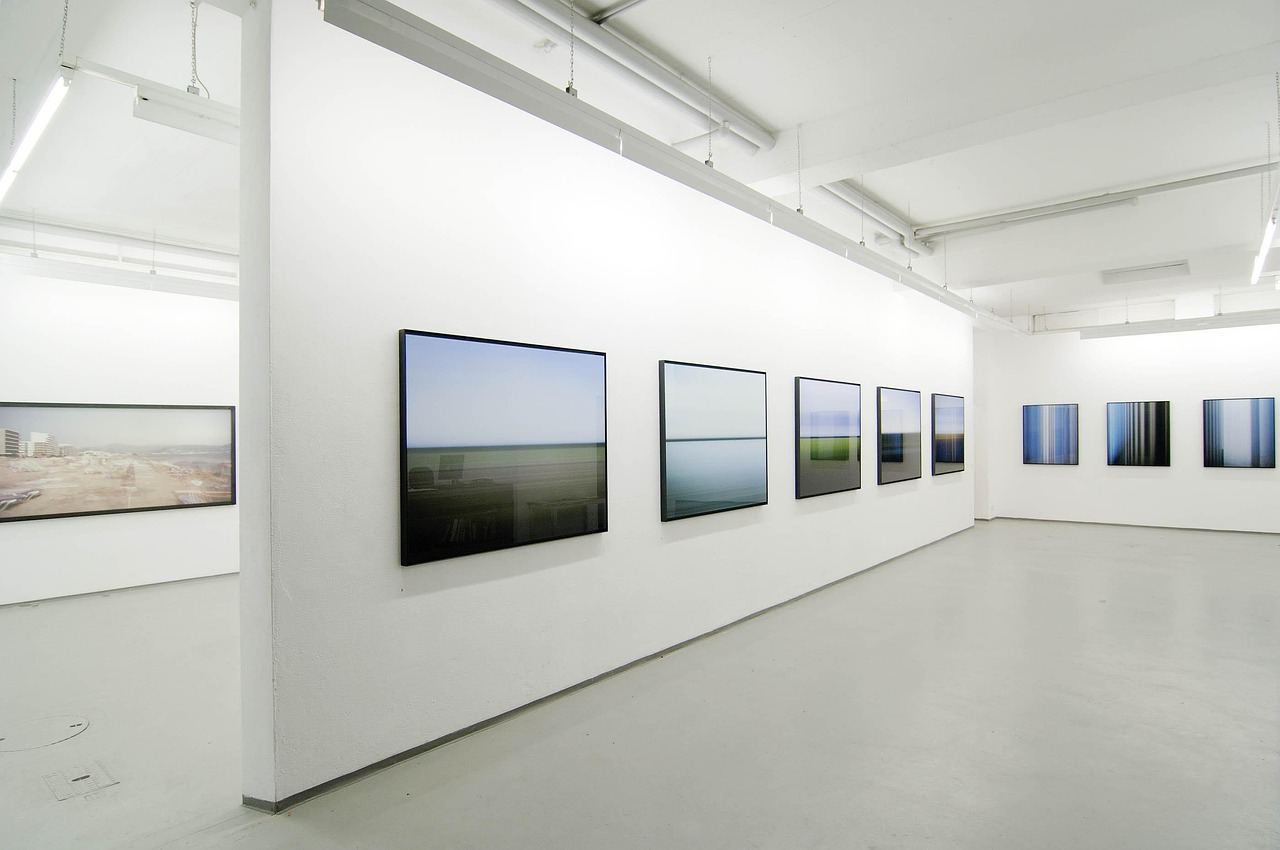
Size matters too. Eden Art says smaller works can be hung slightly higher than eye level, while large works should keep their centre at eye level, which may mean they hang lower overall.
The most common slip is going too high. Passion4Art lists “too high” first among its height errors, marked as the most common.
How do you work out where the hook goes?
The wall needs a hook mark, not just a centre mark. Framebridge’s method, published in October 2023, is to halve the height of the piece and add that to the 57-inch line to find the top of the frame.
- Mark the centre line lightly on the wall with a pencil.
- Measure the frame’s height and divide it in half.
- Add that half to the centre line to mark where the top of the frame will sit.
- Measure from the top of the frame down to the wire or hanger, then drop your hook mark by that distance.
- Check the result with a level before you hammer anything in.
The hardware step matters because wires sag. Eden Art’s own step list builds in the distance from the top of the artwork to the hanging hardware, and tells you to use a level so the piece hangs straight.
Frame depth and glazing affect how a print reads under gallery light, so settle those choices first. The guide to best paper for exhibition prints covers the print side of that decision.
Adjusting for hallways, seated rooms and furniture
The centre line is a starting point. These adjustments come from the same sources:
- Hallways: Framebridge suggests 60 to 66 inches above the floor, because viewers stand closer to the work.
- Seated viewing: Passion4Art gives 48-52 inches for centre height in places such as dining rooms and offices.
- Above a sofa: Passion4Art puts the bottom edge 6-8 inches above the sofa back, while Eden Art says 8 to 10 inches above the back of the couch.
- Above furniture in general: Framebridge suggests the bottom of the frame sits 7 to 10 inches above the top of the furniture.
High ceilings do not change the rule. Framebridge keeps the same 57 inches and notes you should never have to crane your neck to see artwork.
Width counts as well. Passion4Art offers a two-thirds rule: artwork should be 2/3 the width of the furniture below it. If you are unsure of a height, Framebridge’s advice is to go a little lower.
Spacing and layout when you hang photographs as a group
Treat a group as one big piece. Framebridge applies the same centre line to the whole arrangement, so for three frames stacked vertically the middle frame’s centre sits at eye level.
Passion4Art gives typical gaps for each layout:
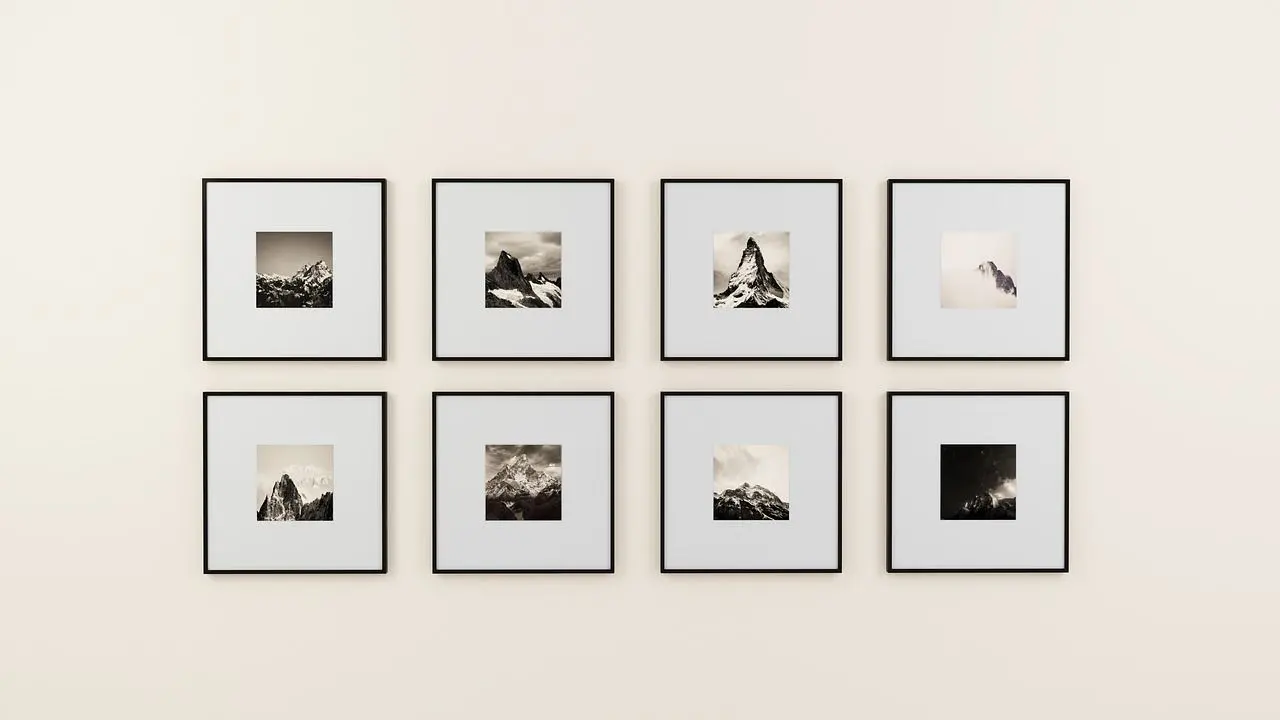
- Gallery wall: tighter spacing of 2-3 inches, treated as a single unit, per Passion4Art.
- Horizontal row: 2-4 inches between frames, aligned by tops, bottoms or centres, per Passion4Art.
- Vertical stack: 3-4 inches between frames, with larger pieces below, per Passion4Art.
- Salon style: 1-2 inches, starting with the largest piece as an anchor, per Passion4Art.
Pick the layout to suit the work. Passion4Art says a perfect grid needs same-size frames, equal spacing, and a start from the centre working outward, while a broken grid with mixed sizes is more forgiving. A series of identically framed prints suits the first; mixed formats suit the second.
Decide the sequence before you measure. The guide on how to curate a photo exhibition covers that earlier stage.
Test the layout before you drill
Paper templates save wall damage. Passion4Art lists a basic kit of tape measure, level, pencil, blue painter’s tape, hammer and stud finder, then a simple template method:
- Cut paper to frame size.
- Tape it to the wall.
- Adjust placement until the group looks right.
- Mark the nail points.
- Remove the paper and hang the frame.
Bring a helper. Framebridge notes that a second set of eyes is very useful when finding the right height, and that is even more true when a row of frames must align across a long wall.
Frequently asked questions
What height should photographs hang at in a gallery?
Show answer
Centre them about 57 inches above the floor, per Framebridge. Eden Art gives a range of 57 to 60 inches for the centre of the piece.
Do I measure to the top or the centre of the frame?
Show answer
Measure to the centre. Halve the frame height and add it to the centre line to find the top edge, then allow for the distance down to the hanging wire.
How far apart should frames on a gallery wall be?
Show answer
Passion4Art suggests 2-3 inches on a gallery wall. Its salon-style layout is tighter, at 1-2 inches.
Should photographs hang higher in a room with a high ceiling?
Show answer
No. Framebridge keeps the same 57-inch centre line, since viewers should never have to crane their necks.